
Still paying a distant data centre monthly fees to summarise documents or index files? Discover how recent developments mean you can now bring many of your AI tasks on-device.
According to recent reports, 91% of IT leaders are reporting friction with their cloud AI providers. Unpredictable “inference fees” (paying every single time your team submits a prompt) and compliance issues are among the biggest headaches.
The good news is we now have a viable alternative.
Many of today’s highly capable AI models can run directly on the laptops and desktops your team uses every day. These AI models are:
Here, we lay out how the AI landscape has rapidly shifted – with practical advice on kitting out your business with the hardware you need to reduce or even end costly cloud bills.
Powerful on-device AI starts from just £31.93 per month – no data centre required!
In brief: By cloud AI, we mean corporate systems and background automations that rent processing power from distant data centres. Every task sends your company data over the internet to a third-party server to do the heavy lifting.
How it differs from a web prompt: Opening a browser to ask ChatGPT or Gemini a quick question uses consumer-facing cloud AI tools. While these also run in the cloud, they are typically standalone applications.
The on-device difference: True local AI (also known as on-device AI) completely cuts out the internet trip, running the actual intelligence models on your office hardware.
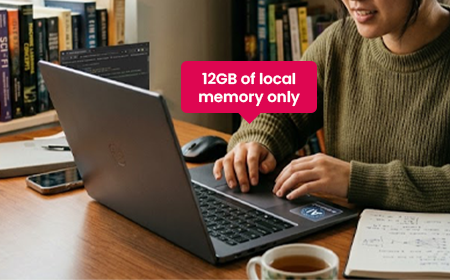
The biggest myth in business tech is that you need a massive, trillion-parameter cloud model (translation: ultra-powerful, ultra-expensive AI) for standard office work.
In reality, a recent Omdia report found that 57% of the AI models businesses typically run are lightweight, sub-10-billion parameter models. These don’t need a data centre; they need just 12GB of local memory. Many laptops today can handle that.
The first wave of professional local AI relied on NVIDIA’s traditional, power-hungry PC graphics cards. It introduced businesses to a highly attractive, fixed-cost model: buy or lease the machine, and your local AI processing is essentially free.
But these devices had a hidden traffic jam: data had to shuffle slowly back and forth between separate memory pools, slowing everything down.
Apple got rid of that traffic jam entirely. Their chips share one big pool of memory instead of splitting it into separate pockets – so nothing has to wait in line.
The result: a 128GB MacBook Pro can run seriously powerful AI models (the kind that used to need a data centre) completely offline, right at your desk.

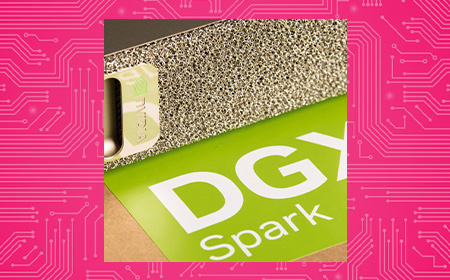
NVIDIA went all-in on power, launching RTX Spark to bring that same kind of on-device AI muscle to everyday Windows laptops.
At the same time, AMD used its Halo platform to deliver powerful local AI performance without the extreme heat, power bills or high costs of a dedicated graphics card setup. AMD setups are generally more affordable too – making them the ultimate setup for department-wide rollouts.
You no longer have to pick a side between a sleek macOS setup or the open flexibility of Windows to get absolute privacy and predictable costs.
The best options right now mean matching the right tool to the job:
Read our blog: Local LLM Hardware Checklist: What Specs Matter
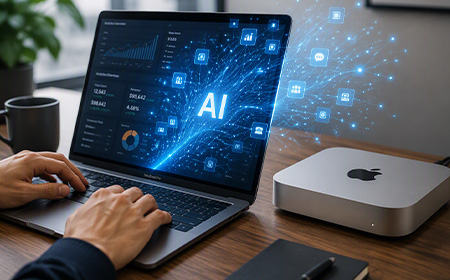
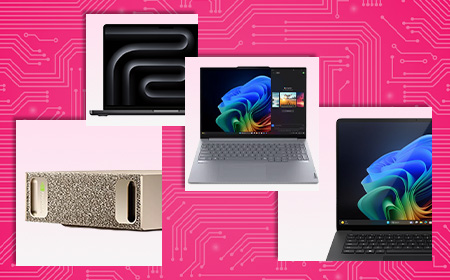
While many tasks can now run entirely on-device, having cloud “waiting in the wings” makes sense for all kinds of business.
Many operating systems are now smart enough to distribute workloads automatically. Your local hardware handles day-to-day work for free – and seamlessly taps into secure cloud servers only when you need the extra muscle for complex projects.
Choose the right hybrid setup with HardSoft.
3 ways to configure a cost-optimised fleet for different teams:
The profile: Creative, marketing or consulting businesses handling everyday text drafting, meeting summaries and basic image workflows.
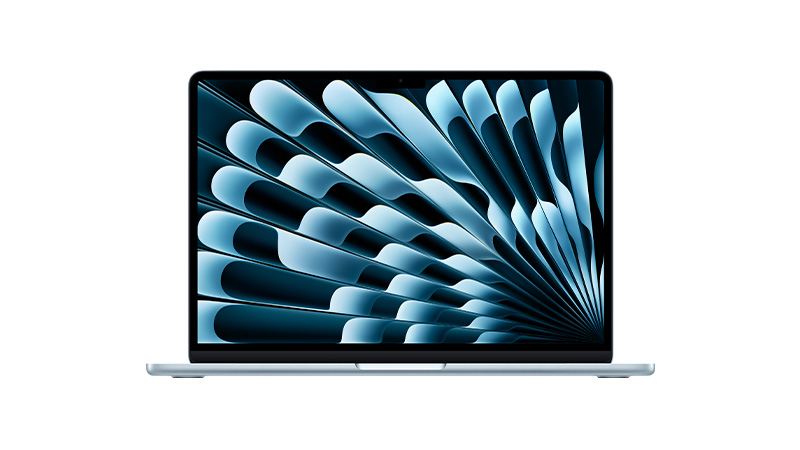
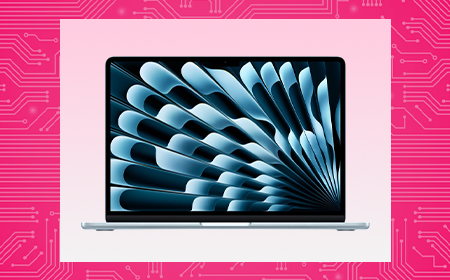
The hardware: MacBook Air with 24GB of memory.
Why it works: 24GB provides ample headroom to host highly optimised sub-15B models locally while keeping standard apps running flawlessly.
Cloud reliance: Rare. Daily productivity fits inside the laptop’s local memory.
The profile: Software development houses, data analysts or teams handling highly sensitive client databases.
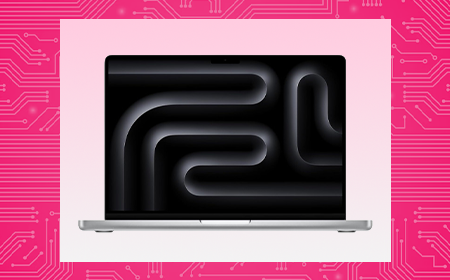
The hardware: MacBook Pro M4 Max with 128GB of unified memory.
Why it works: 128GB shatters standard PC graphics bottlenecks, allowing developers to load advanced 70B and 122B parameter models natively into memory for near-instant code reviews.
Cloud reliance: Optional. Handles the vast majority of core engineering pipelines privately at the desk.
The profile: Legal, financial or recruitment firms where data privacy is paramount and deep client archives must be instantly searchable 24/7.
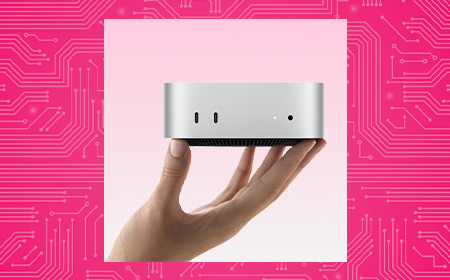
The hardware: Standard staff laptops supported by a fleet of Mac minis acting as “AI agent hubs”.
Why it works: The Mac mini is a silent, low-power background worker. In real-world enterprise rollouts, Apple reports that one customer cut three-year total cost of ownership by over half and energy consumption by 78% after migrating from cloud-based AI to local Mac minis.
Cloud reliance: Yes. Local hubs handle daily sorting securely behind your firewall, tapping the cloud only for heavy, cross-archive analysis.
Set up a 15-minute call with a HardSoft AI expert to find a leasing plan that works for you.
Is running AI locally actually as good as using the cloud? For what your team does day-to-day, yes. In fact, running open-weight models (like Phi-4 or Llama 3.1 8B) locally is often much faster because you bypass internet delays and busy cloud servers.
What about data security? This is the single biggest win for small firms. When you run AI right on your own devices, data never leaves the machine. What stays on your computer cannot be leaked.
Isn’t the upfront cost of AI hardware too high for a small budget? It is a large upfront CapEx if you buy out of the box. That is why many businesses choose to lease.
HardSoft turns unpredictable cloud fees into a single, predictable monthly payment. We handle the financing in-house, preconfigure your AI-ready fleet to your exact specs – and back it with certified support and full lifecycle logistics.
If you’ve spent the last two years watching your team test-drive AI tools, you’ve probably noticed two things: it’s incredibly powerful, and your cloud bills are becoming weirdly expensive.
In 2026, businesses are realising that sending every single prompt to a distant data centre is slow, pricey and a compliance minefield. That’s why the tide is turning toward AI independence — running powerful AI models directly on the laptops and desktops your team uses every day.
This guide pulls together everything you need to know: why businesses are switching, who’s building the best AI hardware right now (Apple, NVIDIA and AMD have all thrown their hats in), and exactly which setup fits your team.
We’ve been kitting out UK businesses for 40 years, so these aren’t generic picks — they’re the machines we actually put on people’s desks.
Let’s clear up the jargon, because three very different things get lumped together.
That last one is the game-changer — and it’s finally practical for everyday business machines.
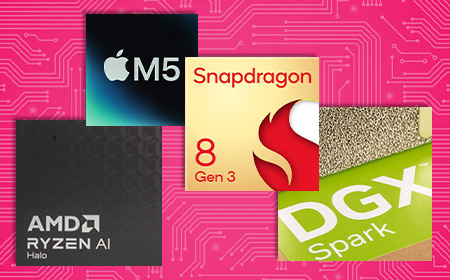
The honeymoon period with cloud-based AI is ending. According to recent market data, a staggering 91% of enterprise IT leaders report significant issues with their cloud AI partnerships — citing data security, cost and disappointing performance. A pivot toward on-device AI tackles three headaches:
Local AI also simply feels faster. There’s no internet round trip to a remote data centre, so responses often begin almost immediately.
At HardSoft, we talk a lot about architectural privacy. It sounds technical, but it’s dead simple: data that never leaves your computer cannot be leaked.
Run AI locally and your customer data, codebases and internal research stay behind your firewall. You can pull the internet cable out of the wall and everything still works — because all the capability and data is on your machine. No 20-page Data Processing Agreement required, because the data isn’t going anywhere.
In regulated sectors like healthcare, finance and law, where data sovereignty is a legal requirement rather than a nice-to-have, that’s enormous.

“Surely my laptop isn’t powerful enough to run a ‘real’ AI?” In 2024, you’d have been right. In 2026, you’re likely wrong.
One of the biggest myths is that you need a massive, trillion-parameter cloud model for everyday tasks. In reality, 57% of the AI tasks businesses run rely on lightweight models with fewer than 10 billion parameters — the ones handling routine data formatting, file indexing and document summaries.
Here’s the catch: most companies are still renting cloud space to run these lightweight models, racking up needless API bills. You’re paying for the big daddy but getting a (more than capable) minnow to do the work.
A 10-billion-parameter model doesn’t need a data centre. It only needs around 12GB of memory to run well, because modern AI formats shrink big models so they run locally without a noticeable drop in quality (it’s called quantisation, if you’re curious). Most high-end business laptops today handle this with ease.
Jargon alert — “parameters.” Think of these as the brain cells of an AI. The headline-grabbing models have trillions, but an AI with 10 billion cells is more than smart enough for conversational AI, complex summarisation and even advanced coding assistance.
The best news for business? This is no longer a one-horse race. In just eight short months the market has completely transformed, and there’s now an AI-ready machine tailored to every role in your company.
It’s a common misconception that Apple jumped on the AI bandwagon. In fact, the company started baking “neural engines” — parts dedicated purely to AI — into its chips back in 2017. Every lesson learned went into the M-series processors that power today’s MacBooks, where the CPU, GPU and Neural Engine all work together.
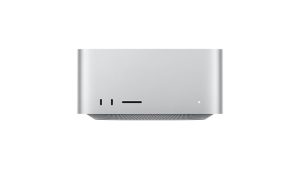
Apple’s secret weapon is Unified Memory Architecture (UMA). In a traditional PC, the processor and the graphics card have separate pools of memory, and shuttling data between them creates a bottleneck. Apple gave the whole chip one massive, shared, high-speed reservoir instead. That’s why a 128GB MacBook Pro can run a 70-billion-parameter model with ease — no cloud required. Need to go bigger? The Mac Studio, with up to 512GB of unified memory, chews through models over 100 billion parameters right at your desk.
This isn’t “toy model” territory, either. Forward-thinking firms are now running massive open-weight models locally with output quality practically indistinguishable from top-tier cloud models — at zero per-token cost and with absolute privacy.
One of the most interesting trends of 2026 is the humble Mac mini as an “AI agent hub” — a small, quiet, low-power machine running background AI 24/7, organising files and monitoring data while you sleep. Under the latest macOS you can even daisy-chain several together into a private AI supercomputer in the corner of the office. For some firms, moving routine tasks off the cloud and onto local minis has cut total cost of ownership by more than 50%.
Bonus: Apple’s Private Cloud Compute handles the occasional oversized task on secure Apple Silicon servers without retaining your data afterwards — and it’s included natively in Apple Intelligence, no extra token fees.
NVIDIA took the early crown by dropping powerful discrete GPUs straight into Windows workstations, letting businesses stop paying per-token cloud fees and start running models in-house. And it isn’t backing down.
Interestingly, 56% of organisations using Macs for local AI also deploy NVIDIA hardware — they’re not switching teams, they’re building hybrid fleets to get the best of both.
NVIDIA’s real trump card is compatibility: because most of the world’s AI software is built for its tech, technical teams prefer it for heavy-duty projects. It’s also pushed into mobile with the RTX Spark platform, powering AI-ready Windows laptops like the Surface Laptop Ultra.
For serious local AI teams, dedicated systems like the HP ZGX Nano and Lenovo ThinkStation PGX run models up to 200B+.
The biggest surprise of 2026 has been the rapid rise of AMD. Rather than chase the biggest, most power-hungry chip, AMD built a brilliant middle ground: significantly more AI performance than a standard office laptop, but without the heat, noise and eye-watering energy bills of a top-tier rig.
Its new Halo chip lineup launches at roughly 20% cheaper than competing NVIDIA options — which makes AMD-powered devices ideal for wide-scale company rollouts, not just a treat for the developers.
It lets whole teams effortlessly run the 57% of everyday AI tasks that don’t need a massive, expensive tech stack.
To build a smart hardware strategy, you need to know which tools need the internet and which run entirely offline.
AI Tool / Platform | Deployment Type | How It Works |
|---|---|---|
| Top-end commercial models (e.g. GPT-4o, Gemini Pro, Claude) | Cloud only | Too large for standard business hardware. They need data centres, so your data must leave your network. |
| Corporate assistants (e.g. Microsoft Copilot, Google Workspace AI) | Hybrid / cloud | Integrated into your apps, but the heavy processing and data retrieval still happen on external servers. |
| Open-weight models (e.g. Llama, Phi-4, Gemma, Qwen, DeepSeek) | 100% local | The full model files sit on your hardware and process data entirely offline, behind your firewall, with total privacy. |
The 2026 rule of thumb: use cloud platforms for massive, creative or web-scale research where data sensitivity isn’t a barrier. For routine automation, private company data and 24/7 background agents, run open-weight models locally on your leased hardware to kill subscription costs and guarantee privacy.
Jargon alert — “open-weight model.” Standard cloud AI keeps its system locked away behind an internet wall. An open-weight model hands you the finished, fully trained settings so you can run it 100% offline with total privacy.

The smartest businesses right now aren’t just buying “faster computers” — they’re building targeted technology portfolios. Think of the switch you made to Netflix: you didn’t rip the aerial off the roof, you kept the BBC and ITV too.
Here, the cloud is Netflix and your local machines are the trusty aerial. Whatever your team size, the goal is identical: absolute privacy, predictable costs and flawless performance.
Business Type | Recommended Hardware | Why It Works | Cloud Use? |
|---|---|---|---|
| Agile team of 10 — creative, marketing, consulting | MacBook Air (24GB) | Runs lightweight sub-15B models locally; perfect balance of portability and capability | Rare — only for occasional heavy workloads |
| Tech-heavy team of 20 — developers, data, sensitive client work | MacBook Pro M-series (128GB) | 128GB unified memory loads 70B–122B models natively for offline code review and deep logic | Optional — for deployment and huge datasets |
| Professional services firm of 50 — legal, finance, recruitment | Standard laptops + Mac mini “agent hubs” | Minis run 24/7 indexing behind your firewall; can cut cloud costs by 50%+ | Yes — for deep analysis across large archives |
| Scaling team of 100+ — everyone needs AI | AMD-powered Windows laptops + NVIDIA workstations | AMD = efficient everyday AI; NVIDIA = heavy technical workloads, without breaking the budget | Yes — for high-volume spikes and multi-department tasks |
| Enterprise of 500+ — global, complex automation | Mac Studio clusters (1TB+ pooled memory) | Sovereign, high-memory local processing for sensitive R&D | Definitely — for ultra-massive, multi-layered workloads |
The strategy today is never about buying the most expensive machine available — it’s about matching the right tool to the job. For raw memory capacity, the Mac Studio and MacBook Pro are hard to beat. For specialist engineering, NVIDIA workstations offer industry-standard software support. For a mobile workforce, AMD ultra-portables and Copilot+ Windows laptops deliver local AI speed with all-day battery.
Don’t see your setup? Talk to our AI leasing experts
Is on-device AI really as good as the cloud? For what most businesses do day-to-day, yes — and it’s often faster, because you’re not waiting on a busy cloud server to respond.
Does “on-device” mean we can’t use the cloud at all? Not at all. The future is hybrid. Modern operating systems are smart enough to process everyday tasks locally for free, then tap secure cloud infrastructure only when you need the extra muscle. You get local privacy and infinite cloud scale.
Isn’t the upfront hardware cost too high? You’re trading a never-ending monthly bill for a fixed cost you can manage. Buying outright is a big CapEx hit, though — which is exactly why leasing is so popular (more below).
What about data security? This is the single biggest win. What never leaves your computer cannot be leaked to third-party servers. No complex data agreements, no exposure.
So the future is hybrid? That’s where we’d put our money. On-device AI brings speed, security and savings; cloud AI is your super-sub for when things get heavy.
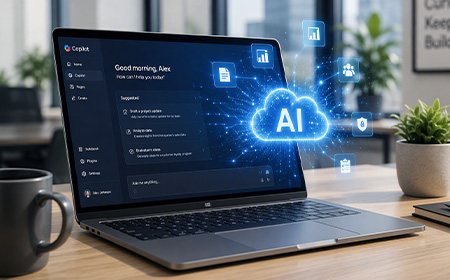
Here’s the honest bit: the hardware that makes on-device AI possible isn’t cheap to buy outright. A capable AI workstation runs anywhere from £2,000 to £7,000+, and buying a fleet of them is a serious capital hit. That’s why the shift to local AI and the shift to leasing go hand in hand — you swap unpredictable cloud fees for one fixed, predictable monthly cost.
Thousands of UK businesses already lease their workplace devices from HardSoft. For a single all-in monthly payment, we supply fully AI-ready tech, pre-configured to your exact specs and backed by Apple- and Microsoft-certified support. You can bundle in insurance, lifecycle logistics, security software and MDM — all on one agreement, with one point of support.
We’ve spent 40 years helping businesses get the right tech at the right time — from global brands like LG and Levi’s to hundreds of fast-growing smaller firms. It’s IT leasing, reinvented.
Whether you’re kitting out a creative team of ten or building a private AI supercomputer cluster, the question is no longer if your business should run AI locally — it’s where. Explore the full range of NVIDIA-powered supercomputers, Copilot+ PCs and Apple Intelligence machines ready to lease today, and cut the cloud cord for good.
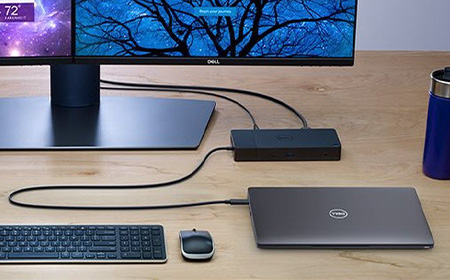

This guide walks you through how to choose the right dock for your business, what the jargon actually means, and which of our docking stations fits which kind of team.
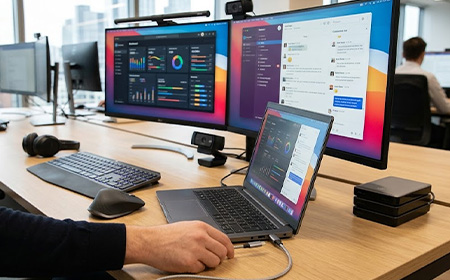
If you’re equipping a team, the laptop is only half the setup. The other half is everything that turns it into a proper workstation and a good docking station does that with one cable.
Your people plug in once, and their laptop charges, their monitors wake up, and every peripheral reconnects exactly where they left it. No adapters, no tangle, no lost minutes at the start of the day.
For hybrid teams, hot-desking offices and laptop-first businesses, it’s one of the highest-impact upgrades you can roll out. We lease and manage IT for UK businesses every day, so we’ve seen what works on real desks.
This is the single most important factor, because it dictates how much your dock can actually do.
A quick check: your laptop needs to support the same standard to get the full benefit. A Thunderbolt 5 dock is brilliant on a Thunderbolt-equipped MacBook Pro, but plug it into a basic USB-C laptop and you won’t unlock its top-tier performance.
If you’re not sure what your devices support, that’s exactly the kind of thing our team will check for you before you order.
Power Delivery, measured in watts (W), is how much charge the dock pushes back into your laptop through that single cable. Get this wrong and your laptop slowly drains even while it’s “plugged in”.
As a rule of thumb: match or exceed your laptop’s own charger wattage and you’ll be fine.
Decide how many external monitors each person needs, and at what resolution, then check two things: the number of video ports and the type (HDMI, DisplayPort or Thunderbolt).
Also confirm the dock supports the resolution you need (4K is the common business standard) across all the screens at once, not just one.
Count what actually lives on the desk: keyboard, mouse, webcam, headset, phone charger, USB stick, SD card reader, external drive. Then make sure the dock has enough of the right ports — and ideally a couple to spare. A dock that runs out of ports on day one just creates a new pile of adapters, which rather defeats the point.
Most business-grade docks include a Gigabit Ethernet port. For office desks this is a genuine advantage: a wired connection is faster, more stable and more secure than Wi-Fi, which matters for video calls, large transfers and security-conscious environments. Every dock in our range includes Ethernet.
Mixed device fleets are the norm now, so it pays to think about compatibility across your whole team. Some docks are happiest on Windows, some are tuned for high-spec Macs, and several are genuinely universal. If you run a blended Mac-and-Windows office, lean toward the universal options so any laptop can use any desk.
Not sure how to match these to your laptops? That’s the bit we’re here for. Tell us what your team uses and we’ll point you to the right dock — no guesswork required. Get in touch.
Here are the docks we’d happily put on any business’s desks, from a tidy entry-level setup right up to a high-end creative workstation.
From £0.75/week · USB-C · 100W-140W power · 2× DisplayPort + 1× HDMI · Gigabit Ethernet
Small, light and seriously capable. The Nano 3x packs multi-display support, a generous 140W of charging and daisy-chain expandability into a compact body that’s perfect for hot desks and hybrid setups.
If you want the cleanest possible one-cable experience at the lowest cost, start here.
Ideal for: hybrid workers, hot-desking offices, anyone wanting maximum value.
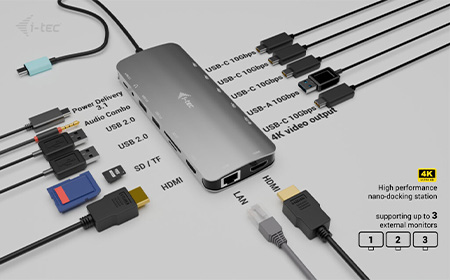
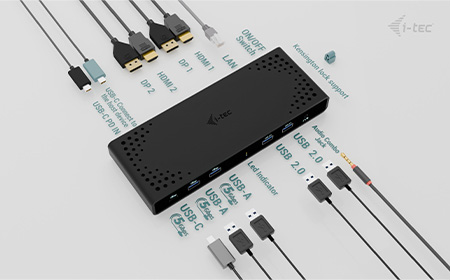
From £1.75/week · USB / USB-C · 100W power · 2× DisplayPort + 1× HDMI · Gigabit Ethernet
The dependable office workhorse. It drives two crisp 4K displays, charges at 100W and plays nicely with both Windows and Mac, making it our go-to recommendation for blended teams who just want everything to work.
A comprehensive set of ports keeps the whole desk connected through one tidy cable.
Ideal for: general office teams running a mix of Mac and Windows laptops.
From £1.75/week · USB-C · 100W power · 3× DisplayPort · Gigabit Ethernet
When two screens aren’t enough, the DX3 steps up to three 4K displays without breaking the bank.
It’s the sweet spot for finance, operations, dev and anyone whose productivity lives across multiple windows at once — all from a single USB-C connection.
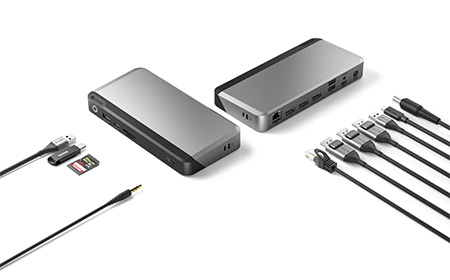
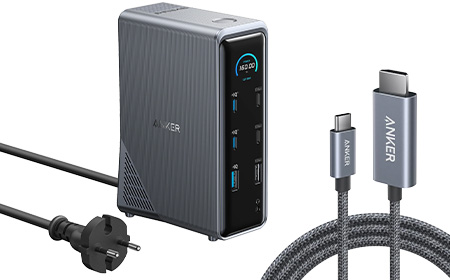
From £2.95/week · USB-C · 140W power · 2× HDMI + 1× DisplayPort · Gigabit Ethernet
A premium 14-in-1 dock that does almost everything. Triple-display support, a strong 140W of charging and smart power management mean it comfortably handles demanding setups across Mac and high-spec Windows machines.
If you want plenty of ports and headroom in a single, polished unit, this is it.
Ideal for: premium multi-display users who want one dock to do the lot. For Touch-First & Interactive Work
From £3.95/week · Thunderbolt 5 · 140W power · 15 ports · Gigabit Ethernet
This is where things get serious. With next-generation Thunderbolt 5 bandwidth, 15 ports and 140W charging, the TS5 is built for high-performance, multi-display environments where speed is non-negotiable. A favourite for high-spec Mac setups and demanding creative or technical work.
Ideal for: creative, engineering and data teams on Thunderbolt-equipped machines.For Multitaskers & Data-Heavy Roles
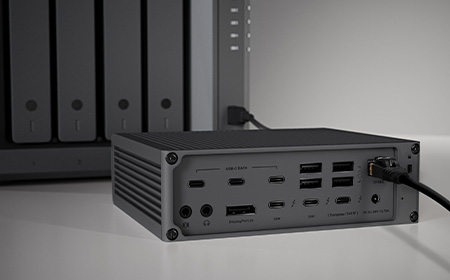

From £4.45/week · Thunderbolt 5 · 140W power · Thunderbolt 5 ports · Gigabit Ethernet · Built-in NVMe SSD
Our top-of-the-range pick. The Echo 13 combines blazing Thunderbolt 5 connectivity and 140W charging with integrated high-speed SSD storage — so editors, photographers and anyone working with huge files get expansion, power and lightning-fast local storage in one unit. The cleanest possible high-end workstation.
Ideal for: high-end creative workstations that move large files all day. For Hybrid Workers & Call-Heavy Roles
| Docking Station | Connection | Power | Displays | Best for | Lease from |
| i-tec Nano 3x | USB-C | 140W | 2× DP + HDMI | Portable / hybrid working | £0.75/wk |
| i-tec Dual 4K | USB / USB-C | 100W | 2× DP + HDMI | Blended Mac & Windows offices | £1.75/wk |
| Alogic DX3 | USB-C | 100W | 3× DP | Triple-monitor productivity | £1.75/wk |
| Anker Prime | USB-C | 140W | 2× HDMI + DP | Premium multi-display users | £2.95/wk |
| CalDigit TS5 | Thunderbolt 5 | 140W | 15 ports | High-performance workstations | £3.95/wk |
| Sonnet Echo 13 | Thunderbolt 5 | 140W | TB5 + built-in SSD | High-end creative workflows | £4.45/wk |
We’ve been kitting out UK businesses for 40 years, and a docking station is rarely bought on its own — it’s part of a wider setup of laptops, monitors and accessories. Leasing it all together, on one simple monthly agreement, keeps things tidy and affordable.
One cable on the desk. One simple agreement for the business. That’s the setup we’d recommend.
Explore all docking stations → or talk to our team about your setup →
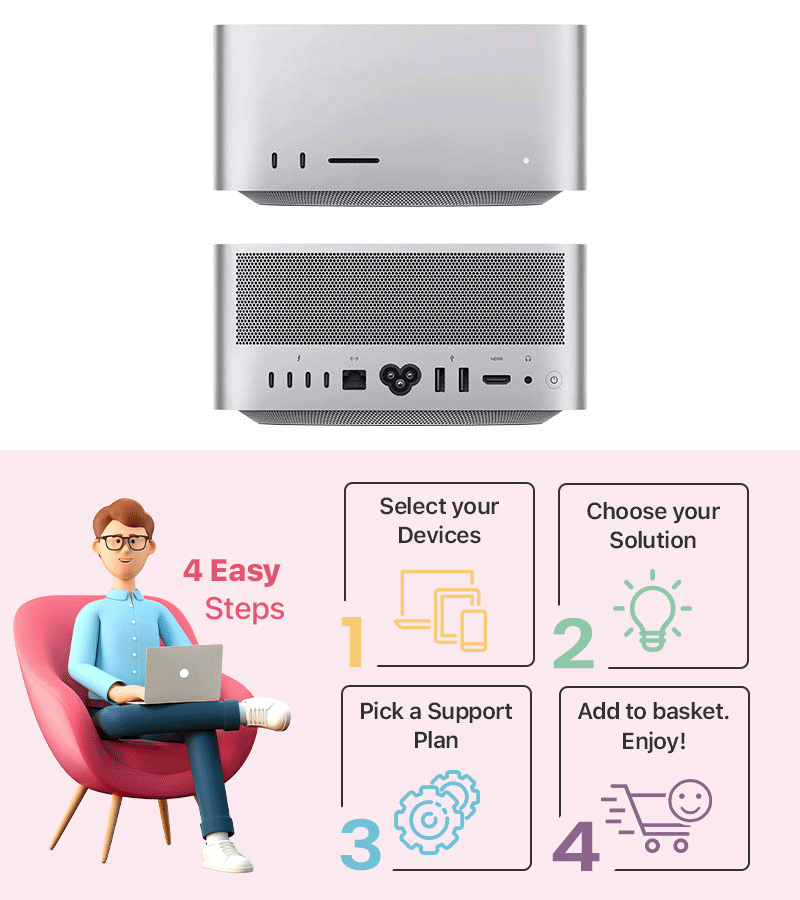
Leasing Apple Mac Studio gives your business a cost-effective way to deploy desktop-class performance without large upfront spend. With powerful Apple silicon like M4 Max or M3 Ultra, Mac Studio leasing supports demanding workflows including video production, 3D design, and software development, all on a compact, energy-efficient device built for professional environments.






What is the Apple Mac Studio used for?
The Apple Mac Studio is a high-performance desktop built for demanding professional workloads such as video editing, 3D rendering and software development. It’s designed for professionals who need workstation-class power in a compact desktop form.
Can you use an Apple Mac Studio with any monitor?
Yes, the Mac Studio supports most modern monitors via its display ports including multiple external displays depending on configuration. It is not sold with a bundled monitor, so buyers choose their own.
Is the Mac Studio good for students?
The Mac Studio is generally more powerful and expensive than most students need; a MacBook Air or Mac Mini is typically better value for standard coursework. It would only suit students working in demanding fields like advanced video production or 3D modelling.
Is the Mac studio good for graphic design and video editing?
Yes, the Mac Studio is well suited to graphic design and video editing, offering high-performance chips, fast storage and support for multiple high-resolution displays. It’s one of Apple’s top choices for creative professionals with intensive workloads.
What’s the difference between the Mac Studio and Mac Mini?
The Mac Studio offers significantly more processing power, memory and connectivity for professional creative and technical work, while the Mac Mini is more affordable, compact desktop for every business and general use. The Studio is priced and positioned as a workstation, whereas the Mini is an entry-level desktop.